Phone:
+85254973791
Email:
support@just-wonders.com

Phone:
+85254973791
Email:
support@just-wonders.com

For many online stores, a flexible return policy can help build customer trust and encourage purchases. However, managing returns across international borders can be difficult. Customers may need to ship products back to another country, pay high shipping fees, and wait longer for their refunds. An overseas warehouse offers a practical way to simplify this process. With local return handling and reliable fulfillment services, ecommerce businesses can create a smoother post-purchase experience and support a 7-day return policy for eligible orders.
For independent online stores, especially Shopify and other direct-to-consumer (DTC) brands, local returns can become an important part of the customer experience. Many medium-sized and large ecommerce clients also pay close attention to whether a service provider can offer overseas warehousing. They want to provide customers with a 7-day no-reason return option through a local warehouse in the destination market. This service requires a suitable local return and processing arrangement, which an overseas warehouse can support.
In this guide, we explain how overseas warehousing works, why local returns matter, and how to build a practical return process for your online store.
International ecommerce gives online stores access to customers in different markets. However, cross-border returns can create operational challenges. A product may reach a customer in a few days, but returning it to the original supplier may take much longer.
An overseas warehouse can help bridge this gap by receiving returned products locally. Instead of asking every customer to ship an item directly back to China, a seller may provide a designated return address in the destination market.
Customers often consider the return process before placing an order. They want to know what happens if a product does not meet their expectations.
A local return address can make the process easier. Customers can send eligible products to a nearby facility instead of arranging an international shipment.
For example, a US customer buys a bag from an independent Shopify store. The customer decides to return it within the store’s stated return period. If the seller has an overseas warehouse in the US, the customer can ship the item to that local facility.
This arrangement can reduce the complexity of international returns. It can also make the store’s return policy easier to understand.
Returning a low-value product internationally may not be practical. Shipping fees can be high compared with the product price. Delivery can also take considerable time.
An overseas warehouse provides a local destination for eligible returns. The warehouse can receive parcels and follow the seller’s instructions for inspection, storage, or further processing.
The exact savings depend on the product, destination, carrier, and return arrangement. Sellers should compare the total cost of local returns with their existing process before choosing a solution.
A clear return process helps customers understand what to expect after a purchase.
When a store offers a local return address and communicates its requirements clearly, customers may feel more comfortable ordering online. A well-managed return process can also reduce repetitive customer service enquiries.
However, a local warehouse does not automatically guarantee a fast refund. Sellers still need clear approval rules, communication procedures, and refund timelines.
A 7-day return policy allows eligible customers to request a return within a specified seven-day period. The exact conditions depend on the store’s policy and applicable consumer protection laws.
An overseas warehouse can support the physical handling of returns. The online store remains responsible for defining the policy, approving requests, and arranging refunds.
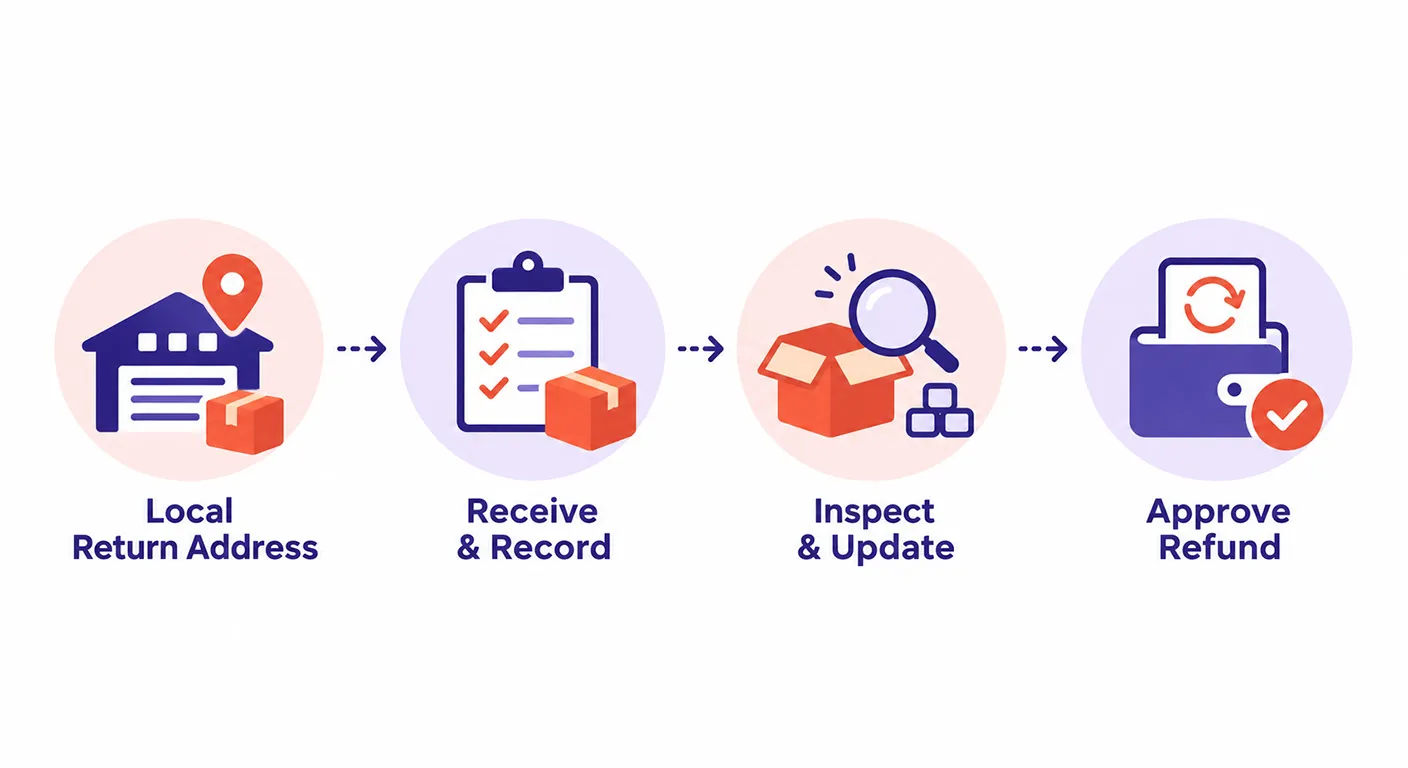
The first step is establishing a designated return address in the target market.
When a return request is approved, the seller provides the customer with the correct return instructions. The customer sends the parcel to the designated overseas warehouse.
Before launching this service, confirm that the warehouse accepts consumer returns. Not every fulfillment facility offers return receiving as part of its standard service.

Once a parcel arrives, warehouse staff can record the shipment and identify the related order.
Useful information includes:
These records help sellers track returns and resolve disputes. They also make it easier to identify recurring product quality or delivery issues.
After receiving a return, the warehouse can inspect the item according to the seller’s agreed requirements.
Depending on the product, the inspection may cover:
The warehouse can then follow the seller’s instructions. Resalable items may be returned to available inventory. Damaged or incomplete items may need separate storage or further review.
Return inspection requirements should be agreed upon in advance. The service scope, handling fees, and reporting format should also be confirmed.
Receiving a return does not automatically mean a refund has been issued.
The seller should establish a clear workflow for reviewing the return request, confirming receipt, checking the product condition, and authorizing the refund.
An overseas warehouse can provide arrival records and inspection results to support the decision. The online store or its designated payment process remains responsible for issuing the refund according to the applicable policy.
This division of responsibilities helps prevent confusion between warehouse operations and customer service.
A reliable return policy needs more than a warehouse address. It also requires clear procedures and communication between the seller, warehouse, and customer.
Before accepting returns, specify how the seven-day period is calculated. Explain whether customers must submit a request within seven days of delivery or meet another clearly defined deadline.
Your policy should also explain:
Check the consumer protection rules in each market where you sell. Some jurisdictions provide mandatory cancellation or return rights that cannot be replaced by a more restrictive store policy. Product exclusions and hygiene-related restrictions may also be subject to local law.
Select a warehouse based on where your customers live and where most orders are delivered.
For example, a store with a large US customer base may benefit from a US-based return facility. A store serving several countries may need separate arrangements for different markets.
Consider the following factors:
A warehouse should match your actual operational needs, rather than simply offering the lowest storage rate.
Returns should be connected to your wider fulfillment services process.
When an order is shipped, the seller should be able to identify the product, order number, and delivery destination. If the customer later requests a return, these details help the team trace the order and prepare the correct instructions.
After the overseas warehouse receives the parcel, the return record should be updated. Inspection results and inventory changes should also be communicated to the seller.
This process reduces manual work and helps keep order records consistent.
Customers need timely updates throughout the return process.
Create standard messages for return approval, shipping instructions, parcel receipt, inspection results, and refund confirmation.
The warehouse should also know how to report exceptions. For example, it may receive the wrong product, a damaged parcel, or an item that does not match the return authorization.
A clear escalation process helps the seller make decisions without unnecessary delays.
Not all warehouses provide the same services. Some focus mainly on outbound order fulfillment, while others can also receive and process returns.
Before selecting a provider, confirm the following details.
Ask whether the warehouse can accept parcels sent directly by consumers. Confirm whether staff can identify returned orders, inspect products, take photos, and provide condition reports.
Also clarify whether returned goods can be placed back into sellable inventory.
Request a clear breakdown of return-related charges. These may include parcel receiving, inspection, repackaging, storage, inventory updates, and disposal when required.
Ask whether there are minimum monthly fees or extra charges for unusual returns. Understanding these costs helps you estimate the total expense of offering local returns.
Check how returned products are recorded and whether the warehouse can communicate inventory changes to your store or inventory management system.
Accurate inventory records are especially important for stores selling multiple variants or managing several sales channels.
Confirm the warehouse’s actual location and the markets it can serve. Do not assume that a warehouse in one country can provide convenient local returns for every international customer.
You should also confirm that your return policy complies with local consumer protection requirements. Warehousing supports the operational process, but it does not replace the seller’s legal responsibilities.
For ecommerce businesses expanding into international markets, warehouse availability can influence the choice of a fulfillment partner.
Many medium-sized and large clients specifically ask whether overseas warehouse services are available. Their goal is not simply to store products closer to customers. They also want to establish a local after-sales process, including a 7-day no-reason return option for eligible purchases.
UploadToSell can provide overseas warehouse services to support these business needs. By discussing your target market, product range, inventory requirements, and return workflow in advance, you can determine how overseas warehousing fits into your overall fulfillment strategy.
Our broader fulfillment approach can also support related operational needs, such as inventory management, order processing, and customized fulfillment arrangements, depending on the agreed service scope.
Before getting started, consider these questions:
These details help define a suitable warehouse arrangement. They also make it easier to clarify costs, responsibilities, and service expectations before operations begin.
If you already have a stable customer base, you may want to start with your main sales market. You can then evaluate return volume, handling costs, and customer feedback before expanding the arrangement.
A clear return policy can help independent online stores provide a more reassuring shopping experience. However, international returns can be difficult when customers must send products across borders.
An overseas warehouse can provide a local return destination and support parcel receiving, product inspection, inventory updates, and other agreed return-handling tasks. Combined with well-organized fulfillment services, it can help sellers build a more practical post-purchase workflow.
For medium-sized and large ecommerce businesses, the ability to support local returns may be an important factor when selecting a fulfillment partner. UploadToSell offers overseas warehouse services to help businesses explore suitable warehousing and fulfillment arrangements for their target markets.
Want to explore overseas warehouse services for your online store? Contact UploadToSell to discuss your target market, inventory needs, and local return requirements. We can help you evaluate a fulfillment arrangement that fits your business operations and customer service goals.
Yes. An overseas warehouse can provide a local address for eligible returns and may support parcel receiving, product inspection, and inventory updates. Your store must still define the return policy and handle refund authorization in line with applicable laws.
No. Some facilities mainly handle outbound fulfillment. Confirm that the provider accepts consumer return parcels and ask which inspection, reporting, and restocking services are available.
Yes. UploadToSell can provide overseas warehouse services. Contact our team to discuss the target market, product type, return volume, and specific handling requirements.