Phone:
+85295718875
Email:
support@just-wonders.com
Phone:
+85295718875
Email:
support@just-wonders.com
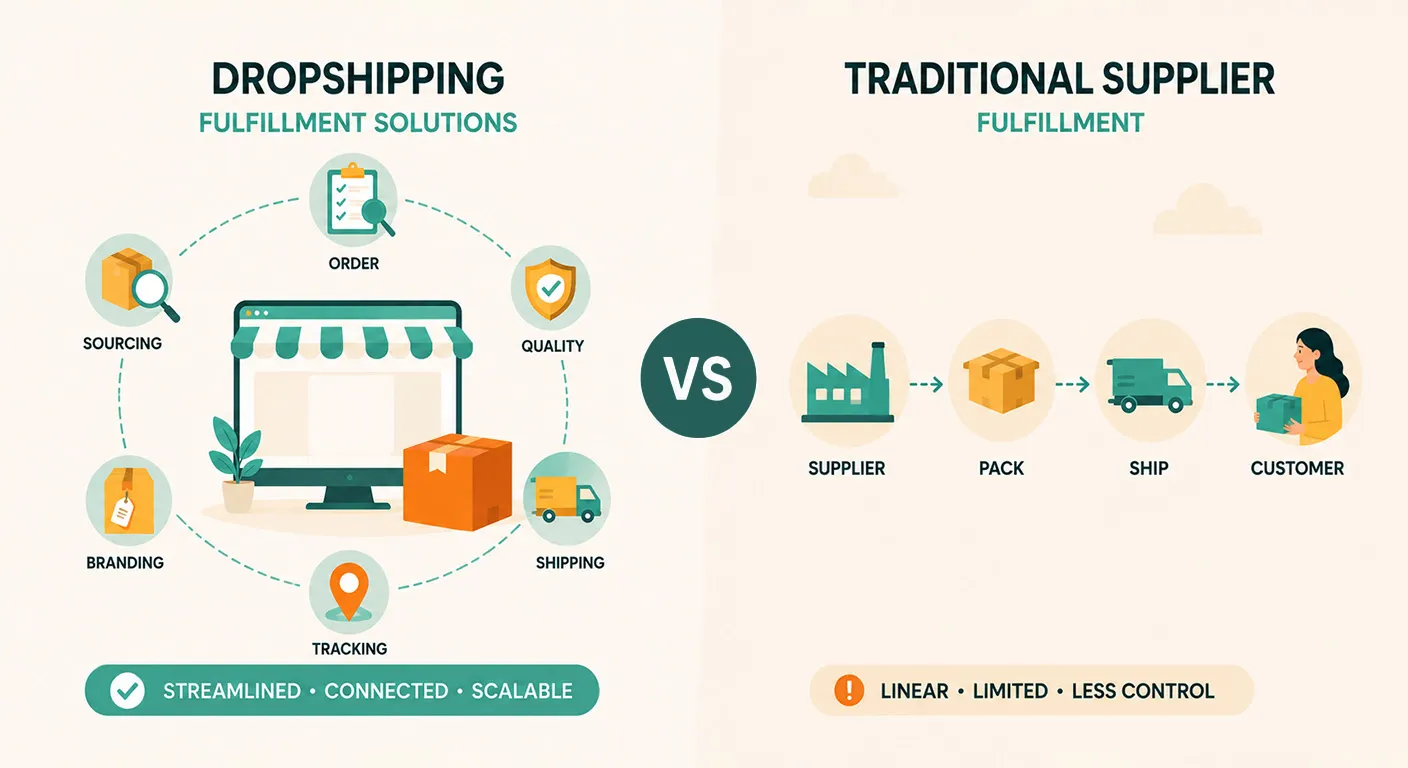
Choosing how to handle orders is one of the most important operational decisions for an online store. Dropshipping fulfillment solutions and traditional supplier fulfillment can both help sellers deliver products without managing a large warehouse, but they work in very different ways. The right choice affects order processing, inventory control, shipping, branding, and the amount of daily work required.
Traditional suppliers often focus mainly on providing products and shipping individual orders. Modern dropshipping fulfillment solutions, however, can connect product sourcing, purchasing, order processing, quality control, shipping, tracking, and branding into one workflow. Professional e-commerce fulfillment services can therefore give sellers more control as order volume grows.
For ecommerce sellers using platforms such as Shopify, the key question is not simply which option is cheaper. It is which model gives your store the right balance of cost, reliability, flexibility, and operational efficiency. This guide compares both approaches and explains how to choose the right model for your business.
At first glance, the two models may appear similar. A customer places an order, a supplier prepares the product, and the product is shipped directly to the customer.
The difference is what happens around that basic process.
Traditional supplier fulfillment usually works like this:
This process can work well for a small number of orders.
Dropshipping fulfillment solutions take a more integrated approach. Order information can move automatically between the ecommerce store and fulfillment system. Supplier coordination, inventory updates, purchasing, packaging, tracking, and after-sales processes can be managed within a more structured workflow.
This difference becomes important when a store starts processing more orders.
Traditional supplier fulfillment is attractive because it is simple to start.
A seller usually contacts a supplier, selects products, agrees on pricing, and asks the supplier to ship orders directly to customers.
This model gives sellers several useful advantages.

Traditional supplier fulfillment normally does not require a large inventory investment. Sellers can test products before committing to larger purchases.
This is useful when you are still evaluating product demand.
You can communicate directly with the supplier about:
For sellers with a small product catalog, direct communication can be enough.
Traditional suppliers can make it relatively easy to test different products. You can introduce a product, monitor its sales, and decide whether it deserves more attention.
However, this model can become harder to manage when order volume increases.
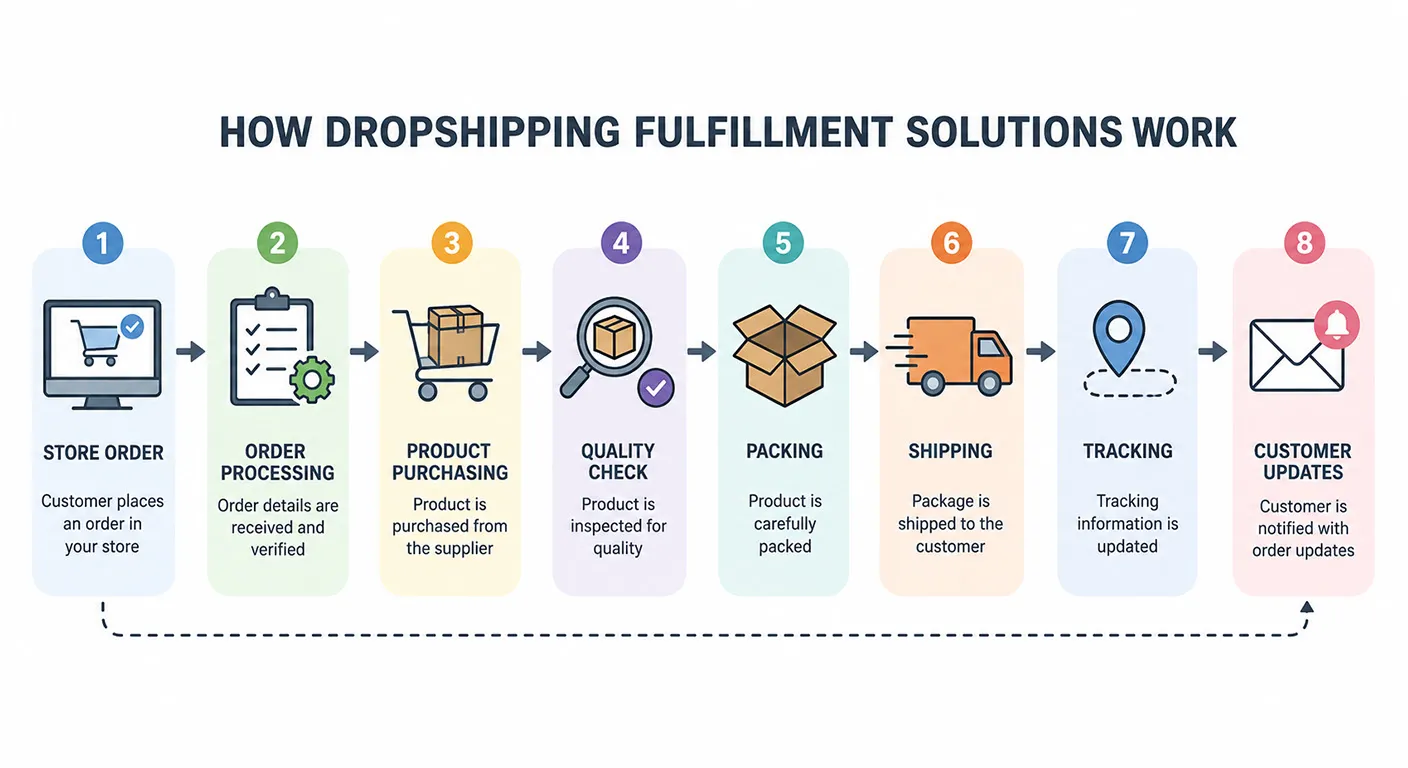
Modern dropshipping fulfillment solutions are designed to reduce the number of manual steps between an order and its delivery.
Instead of treating fulfillment as a separate task, the entire process can be connected.
A typical workflow looks like this:
Store Order → Order Processing → Product Purchasing → Quality Check → Packing → Shipping → Tracking → Customer Updates
This structure can eliminate many repetitive tasks.
For example, when a customer places an order, the fulfillment system can receive the order information automatically. The fulfillment team can then process the order, coordinate with the supplier, arrange shipping, and upload tracking information.
This is one reason professional e-commerce fulfillment services can become more valuable as an online store grows.
Manual order processing takes time.
A seller may need to copy customer information, confirm product availability, place an order, check payment status, and later copy tracking information into the store.
Automation can reduce these steps.
UploadToSell, for example, supports automated fulfillment and tracking workflows. Once orders are processed, tracking information can be transferred back to the ecommerce store.

A fulfillment solution can also reduce the need to communicate with multiple suppliers separately.
This is especially useful when your store sells products from different factories or product categories.
Instead of managing every supplier conversation yourself, you can work through a more centralized fulfillment process.
Traditional supplier fulfillment does not always provide the same level of quality control.
With professional dropshipping fulfillment solutions, sellers can establish quality inspection procedures before products leave the fulfillment process.
This can help identify:
Quality control is particularly important for stores trying to establish a recognizable brand.
The biggest difference between professional e-commerce fulfillment services and traditional supplier fulfillment is operational coverage.
Traditional suppliers primarily provide products.
Modern fulfillment providers can manage a broader part of the ecommerce workflow.
Traditional supplier:
E-commerce fulfillment services:
Traditional supplier:
Inventory information may depend on supplier communication.
E-commerce fulfillment services:
Inventory data can be monitored more systematically, helping sellers identify products that require attention.
Traditional supplier:
Shipping options depend heavily on the individual supplier.
E-commerce fulfillment services:
A fulfillment partner may provide access to multiple logistics channels and help sellers select suitable shipping methods based on destination, product type, and delivery requirements.
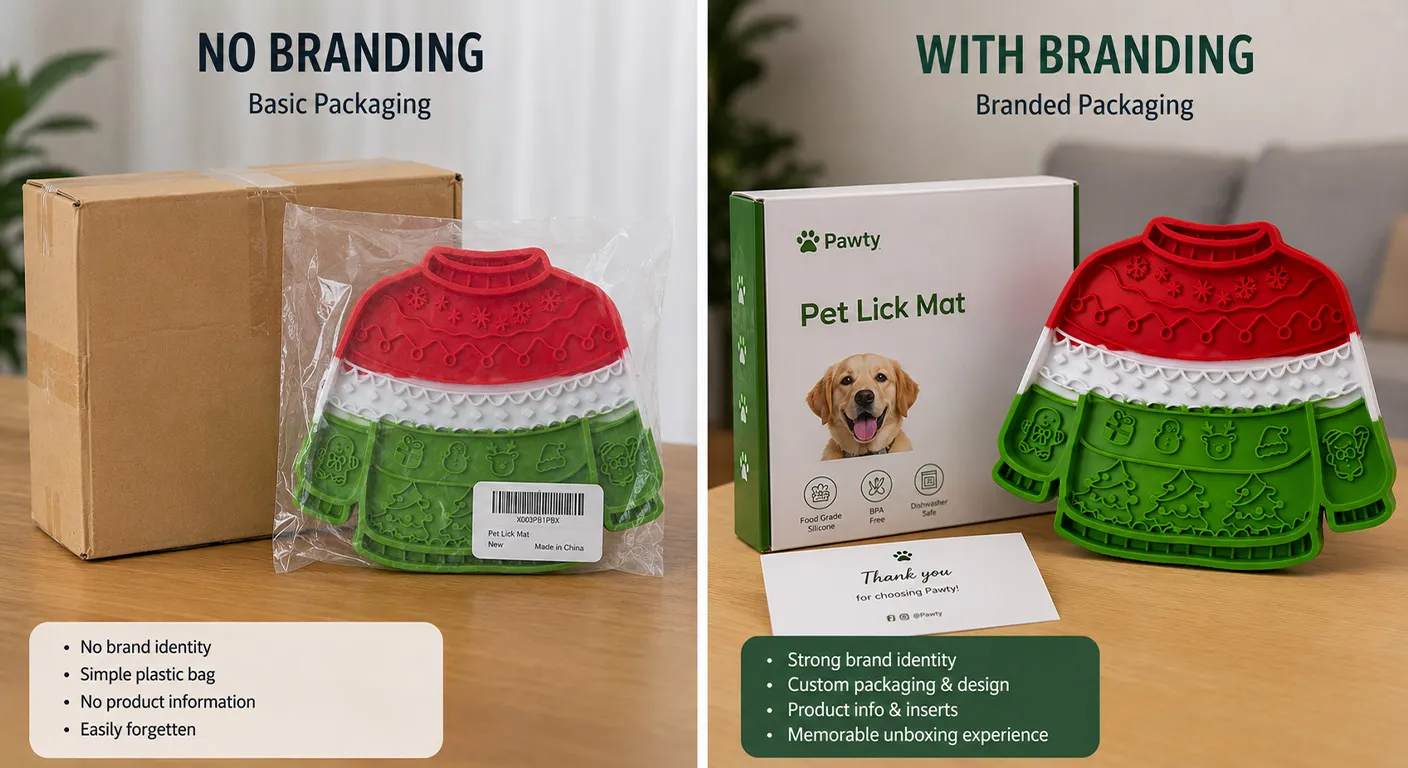
Traditional supplier fulfillment often focuses on getting the product from the supplier to the customer.
Modern dropshipping fulfillment solutions can go further by supporting customized packaging, product inserts, labels, and other brand elements.
For ecommerce sellers building a long-term store, this difference can be significant.
Traditional supplier fulfillment is not automatically the wrong choice.
It can be practical in several situations.
If your store receives only a few orders per day, a simple supplier relationship may be sufficient.
You may not need a complex fulfillment system at this stage.
If one supplier provides stable inventory, consistent quality, reasonable shipping, and responsive communication, traditional fulfillment can remain efficient.
Some products have unique production requirements. Direct communication with a specialized supplier may make more sense than using a standardized fulfillment workflow.
The important point is to match the fulfillment model to the actual needs of your store.
As operations become more complicated, the advantages of integrated dropshipping fulfillment solutions become clearer.
More orders mean more fulfillment tasks.
If every order requires manual processing, the workload grows alongside sales.
Automation allows the system and fulfillment team to handle more orders without requiring the seller to repeat the same administrative tasks.
Managing ten products from one supplier is very different from managing dozens or hundreds of products from different sources.
A centralized fulfillment workflow can make product purchasing and order management easier to organize.
A store that wants to become a recognizable ecommerce brand needs more than product sourcing.
Packaging, product presentation, shipping consistency, and customer communication all contribute to the customer experience.
UploadToSell combines fulfillment with product photography, purchasing, branding, and product sourcing, allowing sellers to manage more parts of the ecommerce process through one partner.
One of the most practical reasons to use e-commerce fulfillment services is time.
Instead of spending hours checking orders and tracking numbers, sellers can spend more time on:
Fulfillment should support these activities rather than consume most of the seller’s working day.
The best approach is to evaluate your fulfillment requirements before choosing a provider.
Look at your average daily and weekly orders.
A store processing a few orders each week may not need extensive automation.
A store processing hundreds of orders needs a more structured system.
If all your products come from one reliable supplier, management is relatively simple.
If your catalog depends on several suppliers, centralized dropshipping fulfillment solutions can provide greater operational control.
Do not evaluate shipping based only on the advertised delivery time.
Look at:
These factors give you a more realistic view of fulfillment performance.
Request samples before scaling a product.
Check:
A fulfillment partner should also have a clear process for handling quality issues.
If your long-term goal is to build a branded store, ask whether the fulfillment provider supports customized packaging and product presentation.
This is an area where professional e-commerce fulfillment services can provide more value than a basic supplier relationship.
One of the easiest ways to compare fulfillment models is to look only at the supplier’s product price.
That is not enough.
Your real fulfillment cost can include:
A supplier with a lower product price may not necessarily provide the lower total operating cost.
For example, if a seller spends several hours each week manually processing orders, that time has a business cost.
Dropshipping fulfillment solutions should therefore be evaluated according to the total workflow rather than the product price alone.
A useful approach is to build your fulfillment process in stages.
Start with a small number of products.
Test product quality, shipping, customer response, and actual fulfillment performance.
Once a product shows potential, verify the supplier’s production capacity, pricing, quality, and shipping options.
Introduce automation for order processing, inventory synchronization, and tracking.
This is where dropshipping fulfillment solutions can start creating meaningful operational value.
After confirming product-market fit, consider custom packaging, product photography, labels, and other brand elements.
When order volume increases, monitor fulfillment metrics continuously.
Useful metrics include:
These numbers help you identify where the fulfillment process needs improvement.
The main advantage of modern dropshipping fulfillment solutions is not simply automation.
It is integration.
When product sourcing, purchasing, quality control, fulfillment, shipping, branding, and support are handled through disconnected suppliers, the seller has to coordinate every step.
An integrated model reduces those coordination points.
This can create a simpler workflow:
Research → Source → Test → Purchase → Fulfill → Ship → Track → Improve
UploadToSell follows this broader approach by combining product selection, purchasing, product photography, branding, fulfillment, and support. Its existing fulfillment services are designed around helping ecommerce sellers manage the process from product selection through delivery.
There is no universal answer.
Traditional supplier fulfillment can be a good option for sellers who have a small order volume, a limited product range, and a reliable supplier.
However, dropshipping fulfillment solutions become increasingly useful when sellers need automation, centralized supplier management, quality control, better shipping coordination, and brand support.
The decision should therefore depend on your current workflow.
If you are still testing products, start simple.
If your store is receiving consistent orders and manual fulfillment is taking more time, consider moving toward professional e-commerce fulfillment services.
For sellers who want sourcing, purchasing, product photography, branding, order processing, and logistics connected in one workflow, an integrated partner can make the entire operation easier to manage.
The goal of fulfillment is not simply to send a package.
It is to create a reliable process that supports the entire ecommerce business.
UploadToSell provides a broader dropshipping infrastructure that combines product sourcing, purchasing, professional product photography, branding, automated order fulfillment, and logistics support. Its platform is designed to help sellers reduce manual work while gaining greater control over the product-to-delivery process.
If your current supplier can handle basic order fulfillment but you need more automation, better coordination, or stronger brand support, it may be time to explore modern dropshipping fulfillment solutions.
A well-designed fulfillment system gives you something valuable: more time to focus on selecting products, improving your store, and building a sustainable ecommerce business.