Phone:
+85254973791
Email:
support@just-wonders.com

Phone:
+85254973791
Email:
support@just-wonders.com
Ecommerce customer support can sit outside fulfillment, but order visibility, reply authority, and escalation must be agreed before customer messages are assigned.
If you use a separate third-party fulfillment provider, you can still consider ecommerce customer support from another team. The key condition is access to accurate order facts: a support agent needs a reliable way to confirm what the warehouse or carrier recorded, and a clear rule for questions that remain unresolved. Ecommerce customer support is the message-handling role; access to order information is a separate permission. Outsourcing replies does not automatically connect two providers or give either one authority to approve refunds, exceptions, or new delivery promises.
That distinction matters when a customer asks, “Where is my order?” Shopify’s guide to ecommerce outsourcing describes assigning particular business functions to a specialist while keeping other functions in-house. This supports the idea that a store can choose separate providers for separate jobs; it does not prove that two providers share systems or records. Your ecommerce customer support arrangement and your fulfillment provider still need a defined information path.
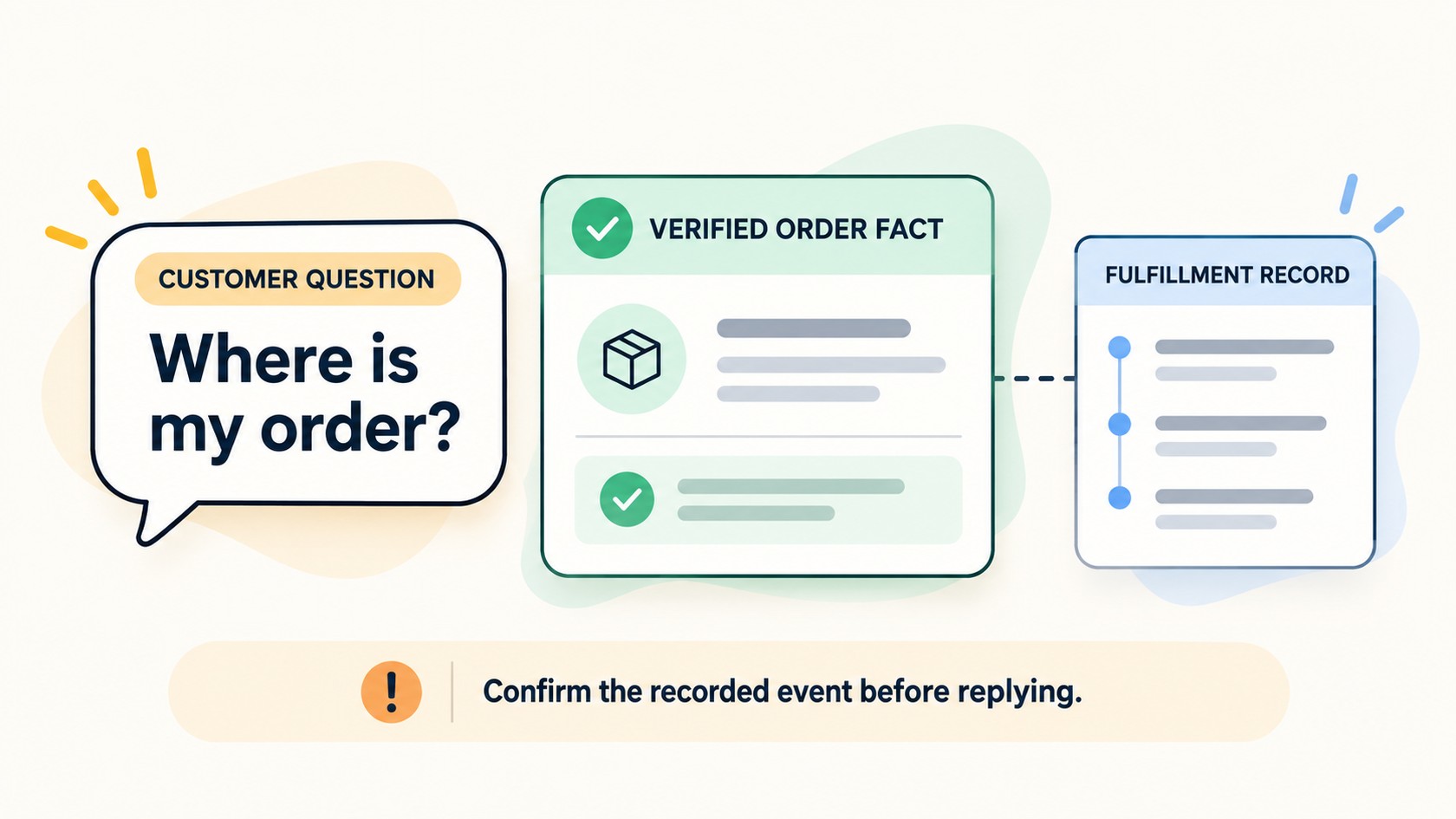
Your store’s order page and a carrier’s tracking page can describe different parts of the same order. The store may show whether an order was fulfilled; a fulfillment provider may hold the warehouse event; a carrier may publish a scan after collection. Shopify’s order-processing guide explains that, after carrier handoff, customers can receive an order-status update with an estimated arrival time. Those records are useful, but a support reply should match the latest verified information available for that particular parcel.
Before a support agent answers a status question, identify which record is authoritative for the question. For ecommerce customer support, a visible status is useful only when its source and meaning are clear. A store confirmation can establish that an order exists. A warehouse confirmation can establish that a parcel was handed over. A carrier scan can show a recorded transit event. None of these alone proves a delivery date unless the relevant provider has confirmed it. If the information disagrees, the safe answer is that the team is checking—not a guessed explanation. That lets ecommerce customer support give a bounded update without turning an unknown into a promise.
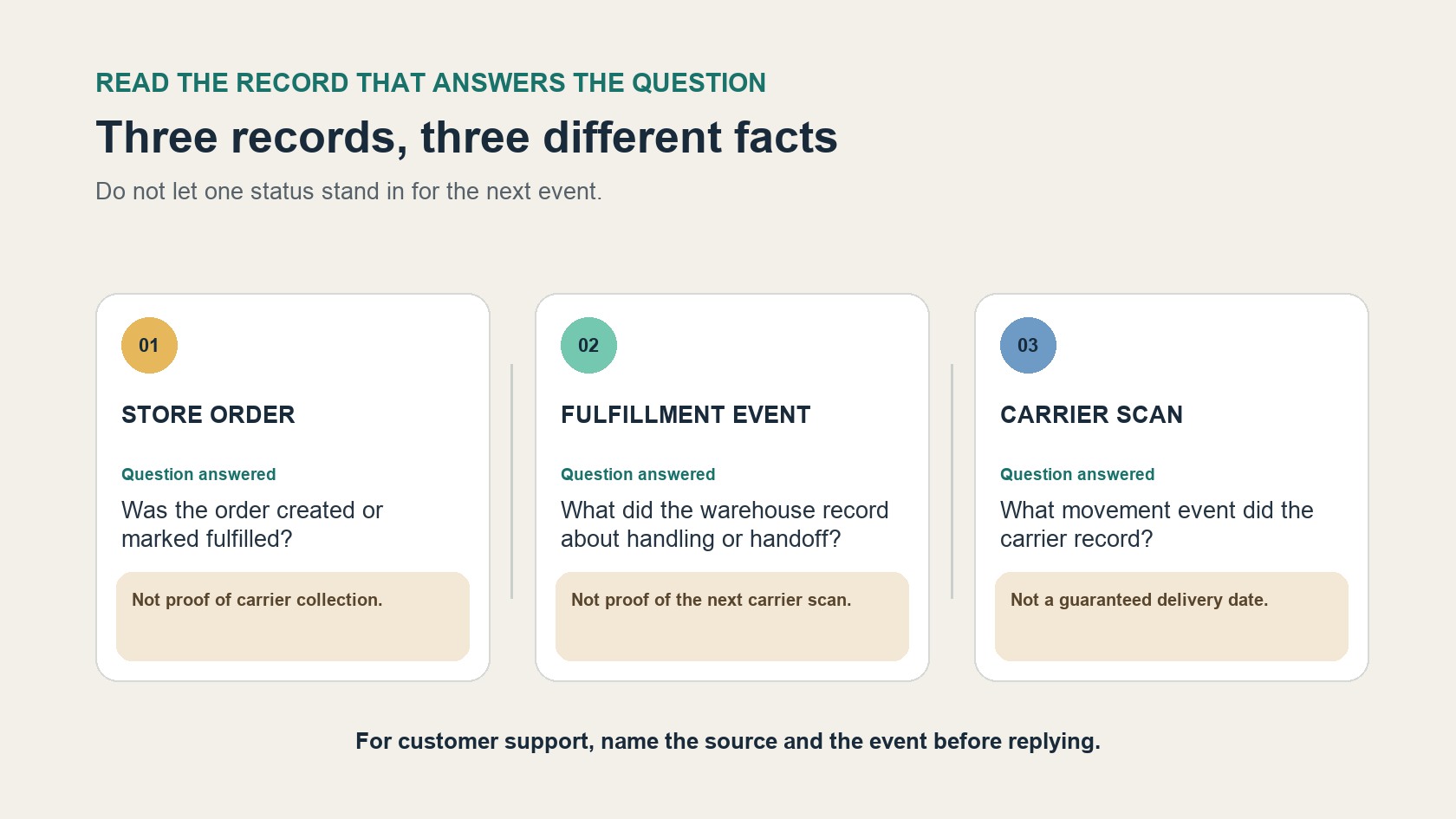
A fulfillment provider can confirm the events it records, while your store remains responsible for its customer policy and commercial decisions. A support partner can communicate an approved update, collect the details needed to identify a case, and route an exception to the person who can decide it. Ecommerce customer support can send the approved answer; it cannot make the seller’s refund decision. It should not promise a refund, replacement, or delivery outcome simply because a message sounds urgent.
This is the same separation between a merchant’s decision and a support team’s reply that we explain in the customer-support handoff for a store policy change. That article focuses on approved policy wording and open cases. Here, the additional question is who can verify physical order events when customer support and fulfillment sit with different providers.
For ecommerce customer support to stay useful across that gap, the handoff should answer three practical questions in plain terms: which order reference identifies the case; who can ask the fulfillment provider to confirm a missing event; and which customer decisions must return to you. This is an information and authority boundary, not a request for you to configure a warehouse system or teach either team how to ship an order. These boundaries matter more when ecommerce customer support and fulfillment are contracted separately.
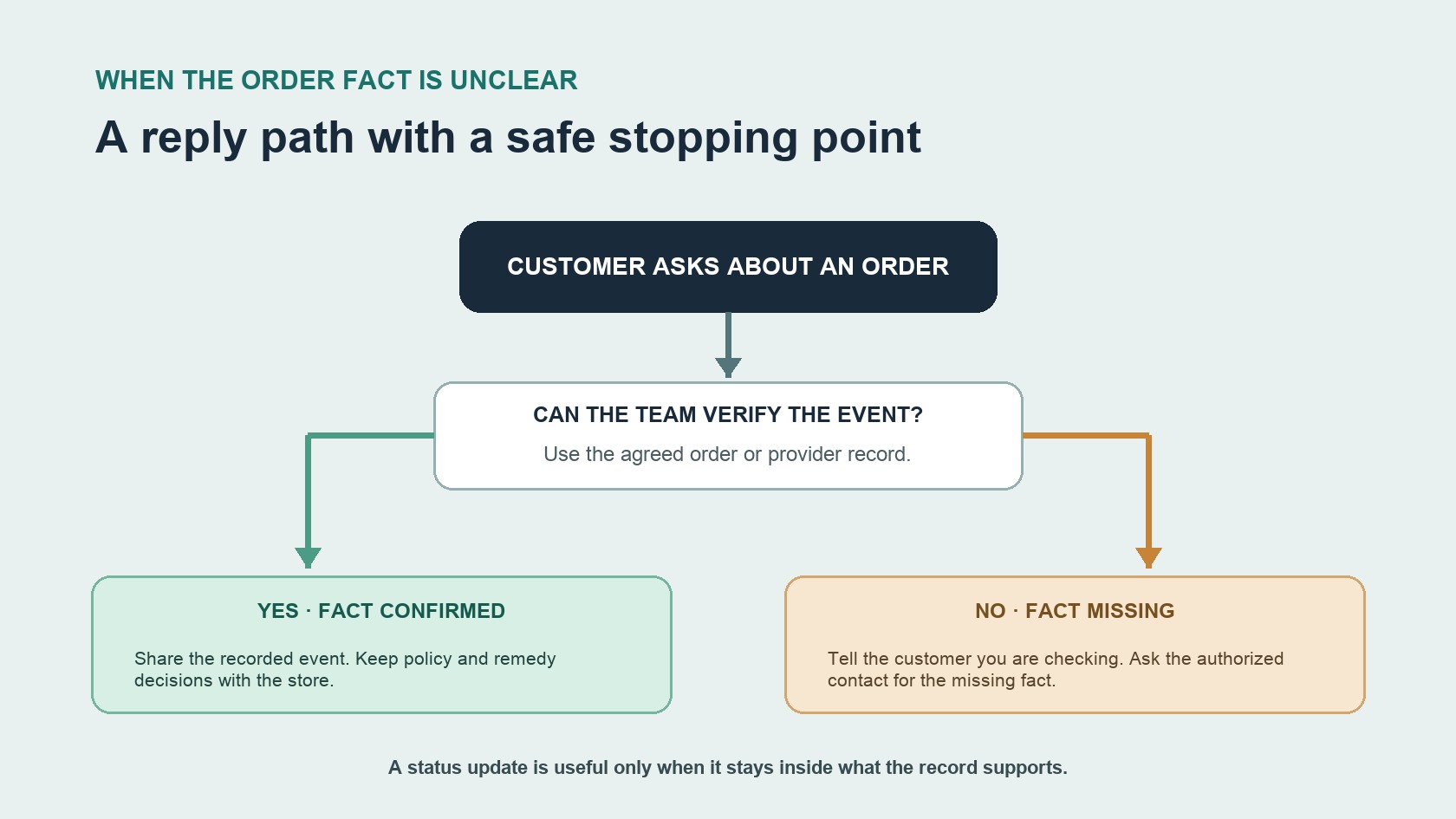
Ask a prospective support team what order status it can actually see, how it will request confirmation from your fulfillment provider, and what it should do while a reply is pending. You may need to authorize access to selected order information or agree on a manual escalation contact. The exact method depends on the providers involved; do not assume an app connection, live sync, response time, or automatic ticket routing unless both sides confirm it. A workable ecommerce customer support arrangement is the one that fits the access actually agreed.
If your fulfillment provider cannot share a current event with the support team, narrow the reply scope. Ecommerce customer support can acknowledge the question and tell the customer that the store is checking, while you or an authorized contact requests the missing fact. If tracking is available but ambiguous, quote only the recorded event and avoid turning it into a delivery guarantee. When facts are clear, the support team can answer without pulling you into every routine message.
UTS’s Shop VA page describes customer-message and order-status assistance connected to its supply chain, including coordination with its fulfillment and logistics teams. That description does not confirm access to every external fulfillment provider, nor does it establish a universal integration or support-only arrangement. If you already use another provider, ask UTS whether the requested support scope fits your setup and what order information or authorization would be needed. The service page is a starting point for that discussion, not proof of compatibility. This keeps ecommerce customer support within the records and authority the providers have actually agreed to use.
For an inquiry, use the usual service-selection flow and share the store, the fulfillment provider, and one example of the order information the support team would need. You can also contact UTS on WhatsApp at 85254973791 and review the prefilled message before sending it. That lets UTS confirm the scope before you assign customer conversations or promise a particular order-status workflow.