Phone:
+85295718875
Email:
support@just-wonders.com

Phone:
+85295718875
Email:
support@just-wonders.com
The European Union is implementing a major change to its customs rules for low-value imports, effective July 1, 2026. For dropshipping sellers who ship products from outside the EU to European customers, this change represents a fundamental shift in how your business economics work.
The long-standing €150 customs duty exemption is being eliminated and replaced with a new €3 fee per item. This article breaks down the new EU customs duty, explains its impact on your dropshipping profit margins, and provides actionable strategies to adapt and thrive under the new rules.
For years, dropshipping sellers relied on the €150 de minimis threshold. Under the previous rules, goods valued at €150 or less could enter the EU without incurring customs duties . This exemption made low-cost, high-volume dropshipping models viable. It allowed sellers to ship individual orders directly from suppliers in China or other non-EU countries without customs duties eating into already-thin margins.
The EU customs duty exemption is being abolished from July 1, 2026 . The Council of the European Union formally adopted this change on February 11, 2026 . The driving reason? Fair competition. The EU argues that allowing millions of parcels to enter duty-free creates an uneven playing field for EU-based businesses that must comply with higher standards and costs .
The new rule applies a fixed charge of €3 per item to all commercial goods valued under €150 entering the EU from non-EU countries . This is a temporary measure that will remain in place until 2028, after which a more comprehensive customs reform is expected .
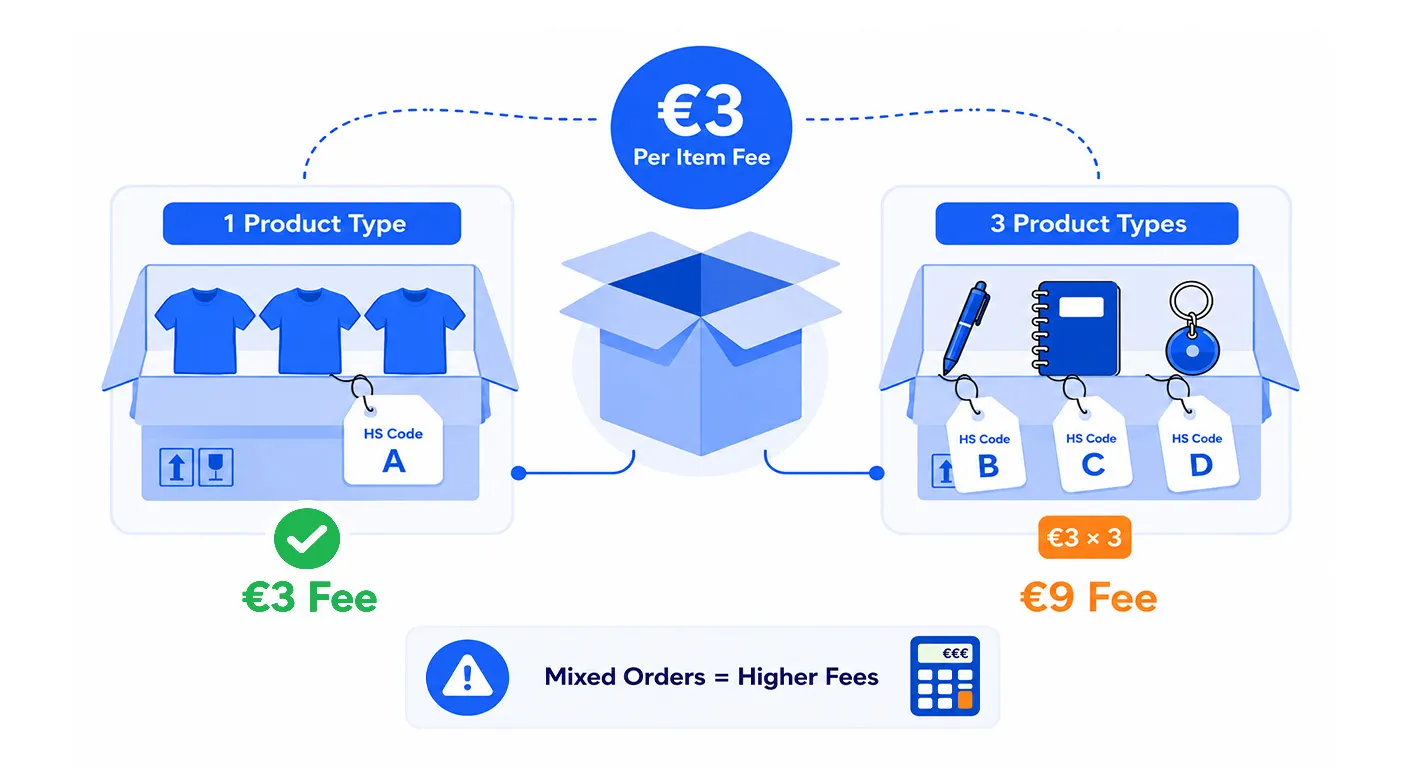
Understanding how this fee works is crucial for dropshipping sellers. The fee is not a flat €3 per package. Instead, it applies per item category, determined by the product’s Harmonized System (HS) code .
Here’s how the calculation works in practice:
For dropshipping sellers, this creates a critical cost variable. If you typically ship mixed-product orders—which is common in dropshipping—you will face multiple €3 charges per package.
The new EU customs duty hits different business models in different ways. Here’s what dropshipping sellers need to understand about the impact on their margins.
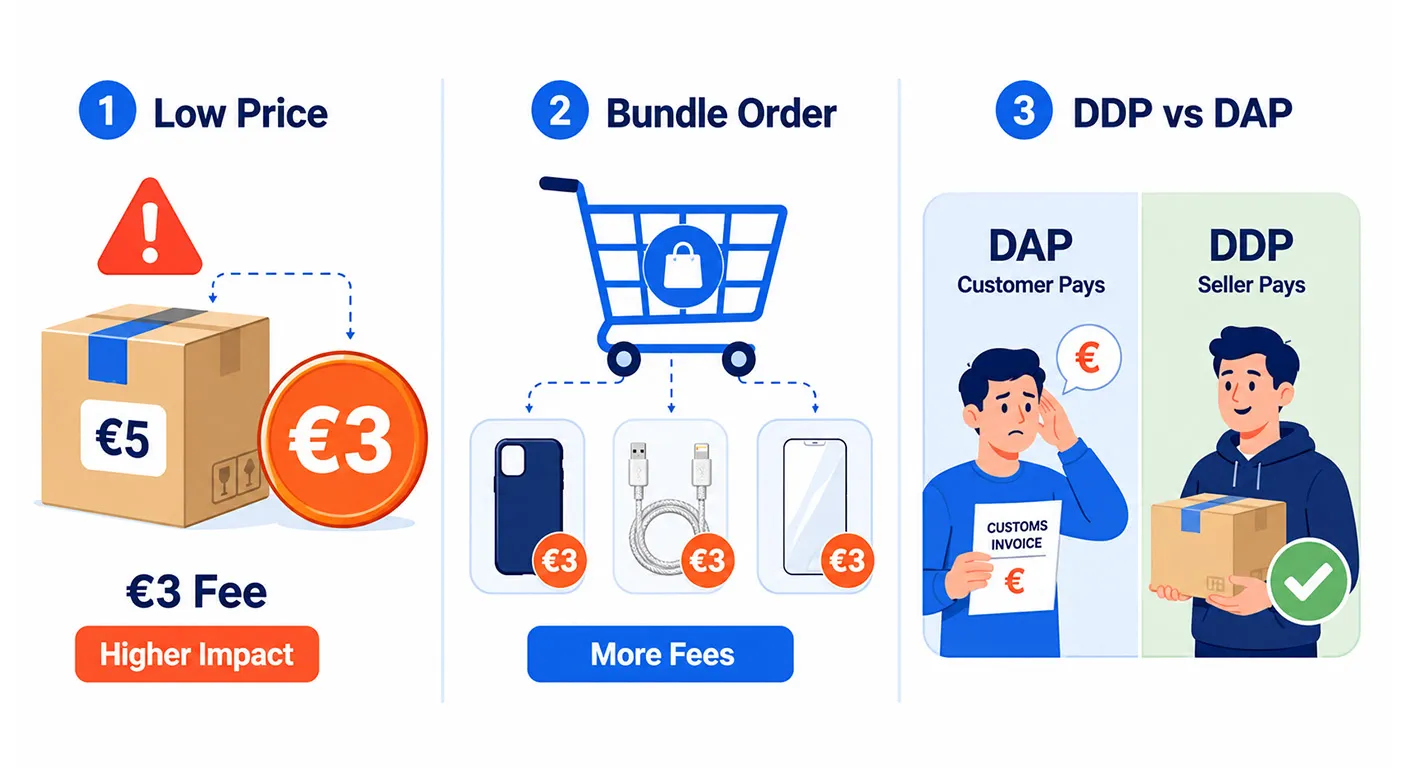
The €3 fee is a fixed charge, not a percentage of product value. This means it disproportionately affects low-priced items . Consider this comparison:
Product priced at €25:
Product priced at €149:
For dropshipping sellers with average order values below €30, the new EU customs duty represents a 10-15% increase in product cost . This is a margin killer for many popular dropshipping items.
The per-item calculation means that orders containing multiple product types face multiple €3 charges. If your typical customer orders a phone case, screen protector, and charging cable together, the customs duty jumps from €3 to €9 or €15 (with the November fee) on a single shipment.
This fundamentally changes the economics of bundling. What used to be a smart upselling strategy now increases your customs exposure.
The EU customs duty must be paid either by the seller or the customer. The choice affects your profit margins and customer experience .
Delivered at Place (DAP): The customer pays the duty upon delivery. This model keeps your upfront costs lower but creates significant friction. Customers who are surprised by unexpected charges often refuse delivery. Refusal rates for DAP shipments typically range from 8-15% . Every refused delivery means lost product, shipping costs, and a dissatisfied customer.
Delivered Duty Paid (DDP): You, the seller, pay the duty upfront and include it in the checkout price. This creates a better customer experience but reduces your margin unless you adjust pricing.
For most dropshipping sellers, absorbing the duty through DDP pricing is the safer strategy—despite the cost—because it protects your brand reputation and reduces delivery refusals.
The EU customs duty changes are not the end of dropshipping. However, they require strategic adaptation. Here are four proven strategies to protect your profit margins.
While the EU remains a massive market, the new customs duty makes it more expensive to serve. This could be an opportunity to diversify geographically.
Consider expanding into markets that maintain higher de minimis thresholds, such as:
Diversification reduces your exposure to a single regulatory change and opens new revenue streams. If you’re selling products that appeal to global audiences, this is the time to test new markets.
Because the €3 fee applies per HS code, dropshipping sellers can reduce costs by minimizing the number of distinct product types in each shipment .
Practical steps:
The ideal scenario is shipping single-item orders. If that’s not feasible, limit the number of distinct HS codes per package.
This approach requires careful analysis. You can counter the increased customs burden by creating bundles that justify higher price points .
For example: Instead of selling a €10 phone case, create a “Protection Kit” that includes a phone case, screen protector, and cleaning cloth for €35. While you pay €9 or €15 in customs duty, the percentage of product value is lower. You can absorb the cost more easily within a higher margin bundle.
The key metric: Target an average order value high enough that the €3 per item duty represents a small percentage of the total. Products priced above €50 absorb the new duty structure more sustainably .
The most direct adaptation for dropshipping sellers is to pivot toward higher-value products and niches. Products in the €50-150 range are less affected by the fixed fee.
Niches to consider:
Higher-value products also tend to:
This strategic shift away from “race to the bottom” pricing can improve your business sustainability in the long run, even beyond the customs changes.
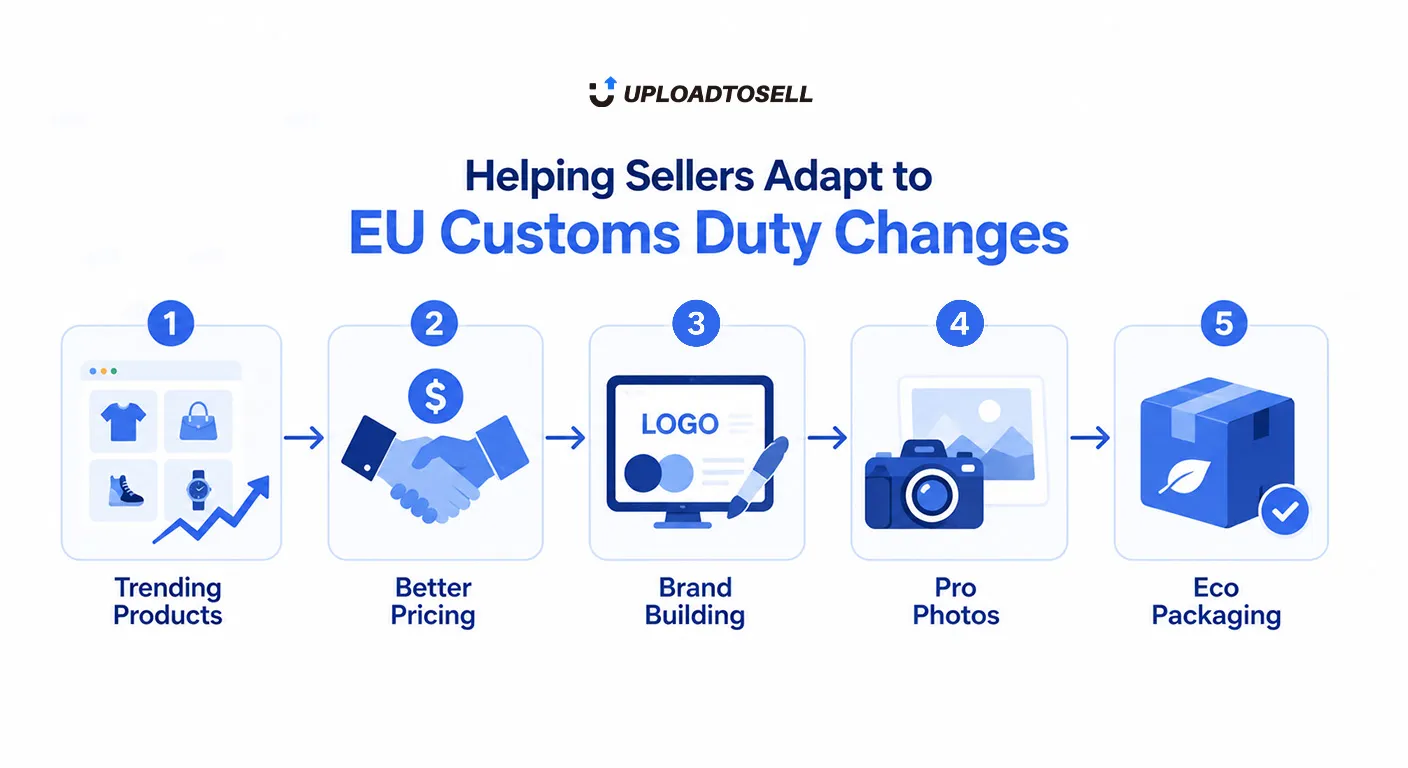
Adapting to the new €3 per item customs duty requires more than just raising prices. To protect your profit margins, you need a complete business strategy—from product selection to brand presentation. Uploadtosell provides an end-to-end solution for dropshipping sellers facing these changes.
1. Smart Product SelectionWe help you identify top-trending dropshipping products with higher perceived value and better margins. Choosing the right items from the start ensures your catalog can absorb the new duty without destroying profitability.
2. Proactive Price NegotiationEvery dollar saved on product cost offsets the customs duty. We leverage our supplier relationships to negotiate better prices, bulk discounts, and improved terms on your behalf—creating a cost buffer that protects your margins.
3. Professional Brand BuildingA strong brand justifies premium pricing. We help you develop a cohesive brand identity and customer experience that sets you apart from low-cost competitors, making customers willing to pay more.
4. High-Converting Product PhotographyPremium pricing demands premium visuals. Our professional photography and video services build trust, highlight product value, and can increase perceived worth by 30-50% compared to basic supplier photos. This is essential for DDP pricing strategies.
5. Sustainable Green PackagingEuropean customers value sustainability. Our eco-friendly packaging solutions enhance the unboxing experience, reinforce brand loyalty, and justify higher prices—making the customs duty easier for customers to accept.
You can tell us your ideas, and our team will create a customized solution just for you.
The €3 per item customs duty takes effect on July 1, 2026. An additional €2 handling fee per HS code will be added from November 1, 2026, bringing the total to €5 per item category .
The €3 fee is charged per distinct item category (HS code), not per package. A parcel containing three different product types incurs €9 (3 × €3) .
All commercial goods valued under €150 imported from non-EU countries are affected. This includes dropshipping orders, direct-to-consumer shipments, and e-commerce imports .
The responsibility depends on your shipping terms. Under DAP (Delivered at Place), the customer pays upon delivery. Under DDP (Delivered Duty Paid), you pay and include it in the checkout price. The EU recommends DDP to avoid delivery refusals and customer dissatisfaction .
No. Orders valued over €150 continue to be subject to standard customs tariffs based on product classification. The €3 flat rate applies only to parcels valued at €150 or less .
Yes. The increased documentation and fee collection requirements at customs may cause processing delays. Sellers using DDP with proper IOSS registration can minimize these delays .