Phone:
+85295718875
Email:
support@just-wonders.com

Phone:
+85295718875
Email:
support@just-wonders.com

Running a dropshipping store looks simple on the surface. You list products, customers place orders, and suppliers ship directly to buyers. But behind every successful store lies a critical practice that many beginners overlook: dropshipping profit tracking.
Without it, sellers are essentially flying blind. They may see revenue coming in, yet have no clear picture of whether they are actually making money. In this article, we will explore why dropshipping profit tracking matters, how it shapes smarter business decisions, and what practical steps you can take to master it.
Many new sellers focus only on gross sales. They celebrate every order notification without calculating the true cost behind it. This is a dangerous habit. Dropshipping profit tracking forces you to look beyond surface-level numbers.
It accounts for product costs, shipping fees, platform charges, payment processing fees, and advertising spend. When you track profit properly, you discover which products make money and which ones drain your budget.
Consider a typical scenario. A seller runs ads for a trendy gadget. The ads generate $5,000 in sales. At first glance, this looks like a win. But after subtracting the product cost, shipping, and $3,000 in ad spend, the actual profit might be only $200.
Without dropshipping profit tracking, the seller would keep pouring money into the same campaign, believing it was successful. With accurate tracking, the seller can either optimize the ad or cut losses early.
Let’s look at a clearer before-and-after example. A seller promoted a wireless charger and generated $4,800 in sales with $2,900 in ad spend. After subtracting product cost ($1,150), shipping ($420), and platform fees ($290), the real profit was only $40.
After switching to better product photos, raising the price by 12%, and cutting underperforming ad sets, the same product produced $5,100 in sales with only $1,850 in ad spend. Real profit jumped to $1,280. Without accurate dropshipping profit tracking, the seller would have kept scaling the original losing campaign.
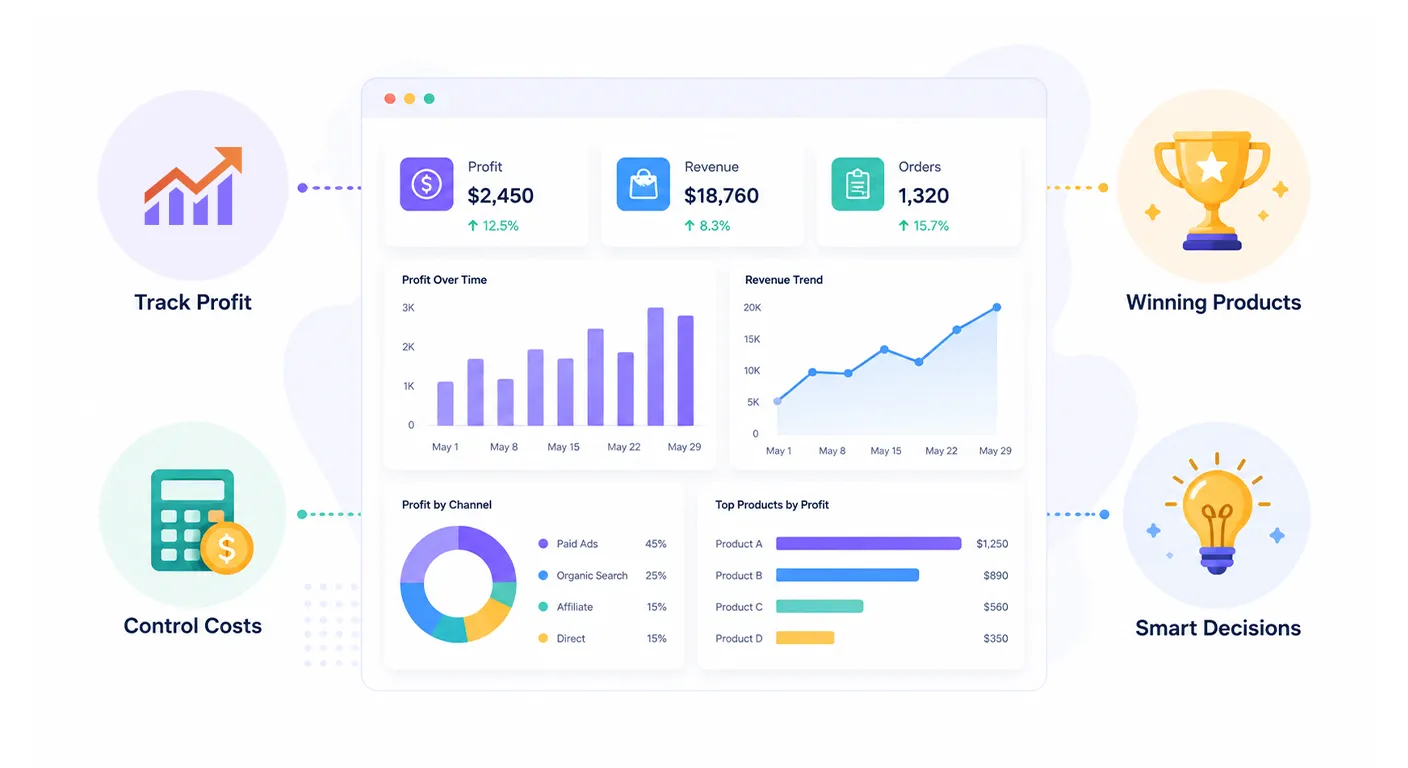
Store profit analysis also reveals hidden patterns. Some products have low margins but high repeat purchase rates. Others bring in one-time buyers who never return. By tracking profit per product, per channel, and per customer, you gain a complete view of your business health. This clarity is the foundation of every smart decision you will make.
Before you can analyze anything, you need clean and organized data. Here are the key components every seller should monitor:
Your supplier price is not fixed forever. Suppliers may raise prices during peak seasons or when raw materials become more expensive. You need to update your cost records regularly. A product that was profitable last month might become a loss leader this month. Store profit analysis depends on having the most current cost data available.
Shipping costs vary by destination, weight, and carrier. Some suppliers offer free shipping, while others charge based on location. In dropshipping profit tracking, you must record the exact shipping cost for every order. Even small differences add up over hundreds of orders.
Shopify, WooCommerce, eBay, and other platforms charge transaction fees. Payment processors like PayPal and Stripe take a percentage of each sale. These fees often range from 2% to 5% per order. Ignoring them will distort your profit numbers significantly.
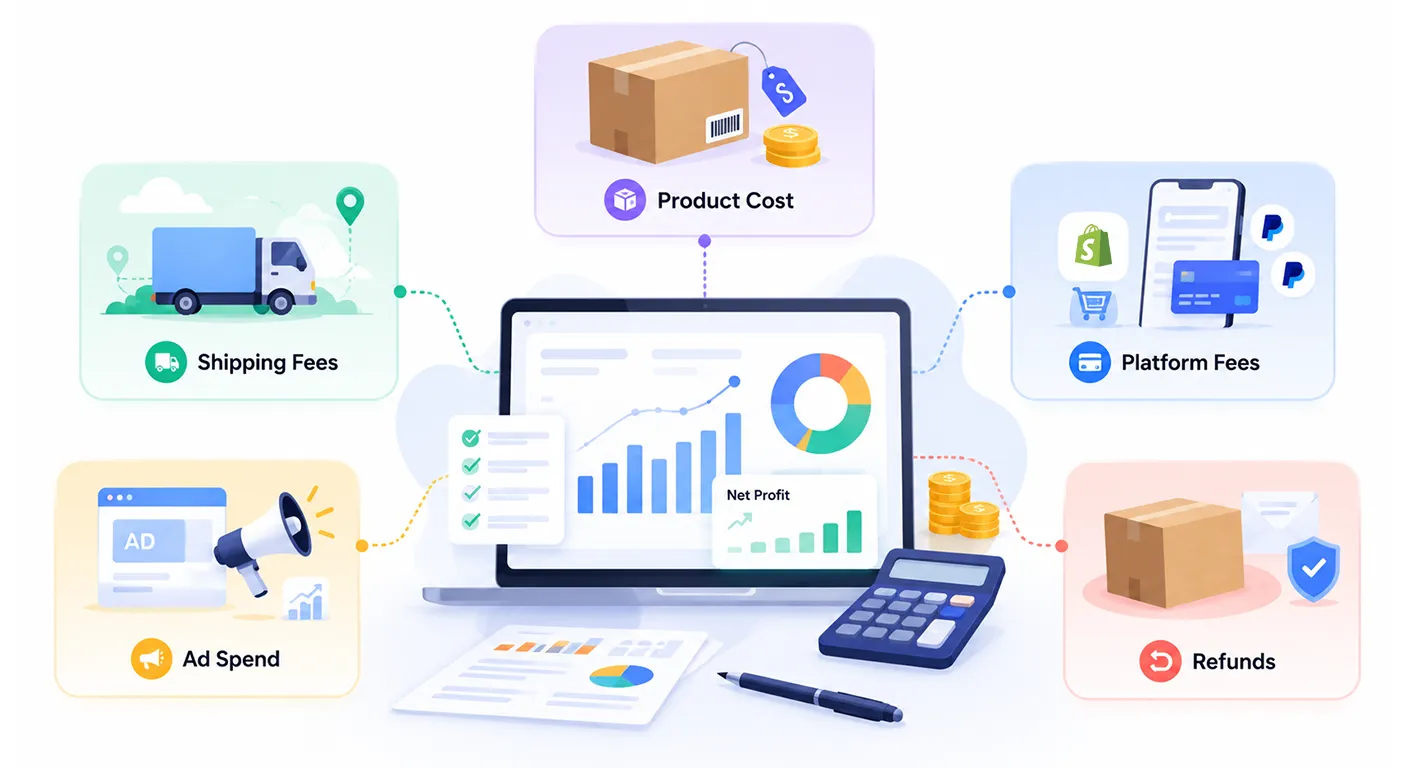
This is often the largest expense for dropshippers. Whether you use Facebook Ads, Google Ads, or TikTok marketing, you must link ad spend directly to each product and campaign. Dropshipping profit tracking should show you the return on ad spend (ROAS) for every item you promote.
Returns are part of e-commerce. A product with a high refund rate can destroy your profit even if the initial margin looked attractive. Track refund rates by product and supplier. This data will guide your inventory and supplier choices.
Once your data is organized, store profit analysis turns raw numbers into actionable insights. Here is how it improves your decision-making across different areas of your business.
Not all products deserve equal attention. Store profit analysis shows you which items contribute the most to your bottom line. You might find that 20% of your products generate 80% of your profit. This insight lets you double down on winners and remove underperformers. You can also identify products with healthy margins but low sales volume. These are prime candidates for increased marketing.
Pricing is not guesswork. With dropshipping profit tracking, you can test different price points and measure the impact on profit. Sometimes raising the price by 10% reduces conversion slightly but increases overall profit. Other times, a lower price drives enough volume to improve margins. Data removes the guesswork from pricing.
Every ad dollar should work hard for you. Store profit analysis connects marketing spend to actual profit, not just revenue. You may discover that Instagram ads bring high-revenue customers with low margins, while email marketing brings repeat buyers with excellent margins. This knowledge helps you shift budget toward the most profitable channels.
Your suppliers are partners in profit. Dropshipping profit tracking reveals which suppliers deliver quality products with reliable shipping at fair prices. If one supplier consistently causes delays or quality issues that lead to refunds, the data will expose the problem. Armed with order volume data, you can also negotiate better rates with your top suppliers.

Profit and cash flow are not the same. A store can be profitable on paper but run out of cash due to delayed payouts or high upfront ad spend. Store profit analysis helps you forecast cash needs. You can see when big ad bills are due and plan your spending accordingly. This prevents the stress of unexpected cash shortages.
Now that you understand the importance of dropshipping profit tracking, here are practical methods to implement it effectively in your store.
Spreadsheets work for beginners, but they become messy as order volume grows. Consider using specialized software that integrates with your store and ad platforms. These tools automatically pull in costs, fees, and revenue. They generate real-time dashboards that show profit by product, by day, and by campaign. This saves hours of manual work and reduces human error.
Set a weekly reminder to review and update product costs. Check for supplier price changes, shipping rate adjustments, and new platform fees. Dropshipping profit tracking is only accurate when your cost data is current. A 15-minute weekly review can prevent major profit leaks.
In your ad accounts and analytics tools, use consistent naming conventions. Tag each campaign with the product name, audience type, and date. This makes store profit analysis much easier. When you review performance, you can instantly see which combination of product and audience is most profitable.
Do not settle for rough estimates. For every order, calculate: sale price minus product cost, minus shipping, minus fees, minus ad spend attributed to that sale. This gives you the true profit per order. Over time, this granular data builds a powerful picture of your business.
Never scale an ad campaign based on revenue alone. Always check the profit report first. A campaign with $10,000 in revenue and $9,500 in costs is not worth scaling. Dropshipping profit tracking protects you from the trap of growing revenue while shrinking profit.
Revenue is vanity, profit is sanity. Set monthly profit targets for your store. Break these down by product category and marketing channel. Store profit analysis then becomes a scorecard that tells you whether you are on track. This mindset shift changes how you approach every business decision.
Spending 20–30 minutes on this checklist every week prevents most profit leaks.
Even experienced sellers make errors in dropshipping profit tracking. Here are the most common pitfalls and how to avoid them.
Many sellers forget about currency conversion fees, chargeback fees, and subscription costs for apps and tools. These small charges add up. Include every business expense in your tracking to see the real picture.
If you run more than one store, keep the data separate. Blending numbers makes store profit analysis meaningless. What works for Store A may fail for Store B. Track each store individually.
A product may lose money in the first month but become profitable as you optimize ads and increase supplier volume. Give new products enough time before cutting them. At the same time, do not hold on to losers for too long. Use dropshipping profit tracking to set clear rules for when to pause or kill a product.
Some products look weak on the first order but become highly profitable over time.
For example, a product with only $4 profit on the first purchase may generate three more orders from the same customer within six months. That raises the lifetime profit to $16.
Simple way to estimate customer lifetime value: Average Order Profit × Average Number of Orders per Customer. Always include this number when deciding whether to keep or drop a product. Low first-order margin + high repeat rate often beats high first-order margin + zero repeats.
Tracking profit accurately takes time and discipline. Many sellers struggle because they are busy with customer service, marketing, and order management. This is where professional support becomes valuable. Having a team that handles accounting, data organization, and cost monitoring frees you to focus on strategy and growth.
A reliable support system can help you set up proper tracking structures from day one. We ensure that every cost category is captured correctly. They generate regular profit reports that highlight trends and flag problems early. With expert help, dropshipping profit tracking becomes a seamless part of your workflow rather than a burdensome task.
Success in dropshipping is not about luck. It is about making informed decisions based on accurate numbers. Dropshipping profit tracking gives you the clarity to choose the right products, set the right prices, and invest in the right marketing channels. Store profit analysis transforms your store from a guessing game into a predictable, scalable business.
If you are ready to take your dropshipping business to the next level, UploadToSell offers a complete dropshipping solution that includes high-converting product photography, design customization, trusted supplier connections, virtual customer service, and cost optimization based on data. Our accounting support helps organize product costs, shipping expenses, order income, profit, and cash flow. Clearer records make it easier to understand business performance and make informed decisions as your store grows. Let UploadToSell handle the operational details while you focus on what matters most: building a profitable, sustainable dropshipping business.
Sales revenue only shows money coming in. Profit tracking subtracts every cost — product, shipping, ads, platform fees, and refunds — so you know whether you are actually making money or losing it.
You should include product cost, shipping and fulfillment fees, platform transaction fees, payment processing fees, advertising spend, refunds, chargebacks, and any other business expenses such as app subscriptions or currency conversion fees.
Update them at least once a week. Supplier prices and shipping rates can change quickly, and outdated cost data will make your profit numbers inaccurate.
Yes, spreadsheets work when order volume is low. Once you have dozens of orders per day or run multiple ad campaigns, specialized tools that automatically pull data from your store and ad platforms become much more reliable and save time.
It shows which products generate real profit after all costs. You can double down on the top performers and stop spending time and ad budget on items that look popular but lose money.